
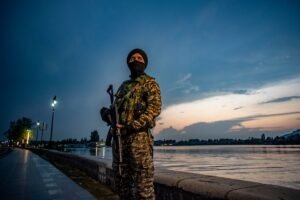

The United States President Donald Trump stated on Saturday that India and Pakistan have entered into a cease-fire agreement after a short phase of conflicts over recent days.
On Saturday morning, the neighboring countries exchanged attacks on each other’s military installations when Pakistan initiated “Operation Bunyan Marsoos” following an assault on three of its airbases via Indian air-to-surface missiles. Despite both nations asserting they had thwarted many incoming weapons, they acknowledged that several hits resulted in destruction.
Over 60 individuals have reportedly lost their lives since India initiated missile strikes as part of “Operation Sindoor” on Wednesday. The Indian government claims these attacks were aimed at “terrorist camps” within Pakistan and Pakistani-controlled Kashmir. Meanwhile, Pakistan acknowledges that 13 people died on its side of the Line of Control (LoC)—the actual frontier separating the two nations and bisecting the contested territory of Kashmir.
The strikes sparked concerns about an expanded confrontation between these two nuclear-capable nations. Although past interventions have helped settle disagreements between India and Pakistan, it is uncertain if this truce will endure and if citizens can breathe easier as a result.
What agreements have been reached between India and Pakistan?
Following extensive negotiations facilitated by the United States throughout a lengthy night, I’m delighted to share that India and Pakistan have concurred upon an instant and comprehensive cessation of hostilities,” Trump posted on his Truth Social account on Saturday.
” Congratulations to all nations involved for employing Common Sense and Remarkable Intellect. Thanks for giving due consideration to this issue!” Several countries are known to have participated in these discussions.
Pakistan’s Foreign Minister Ishaq Dar and India’s Foreign Secretary Vikram Misri soon affirmed the cessation of hostilities following their confirmation.
“It was agreed between them that both sides would stop all fighting and military action on land, air and sea with effect from 17:00 Indian Standard Time today [11:30 GMT],” Misri said in a short statement.
“Instructions have been given on both sides to give effect to this understanding. The directors general of military operations will talk again on May 12 at 12:00.”
India and Pakistan have likewise established military communication lines and hotlines after the agreement, as per Dar.
Is it likely that these two nations will continue their discussions?
US Secretary of State Marco Rubio also
said
India and Pakistan had agreed to start talks on a “broad set of issues at a neutral site”.
However, in a statement on social media, India’s Ministry of Information and Broadcasting partially denied this, stating: “There is no decision to hold talks on any other issue at any other place.”
Subir Sinha, director of the South Asian Institute at SOAS University of London, told Al Jazeera that broader bilateral talks would be a very challenging process as India had previously rejected such a development.
“One of the arguments about this so-called robust policy towards Pakistan that Modi’s government had adopted was that it was no longer possible to sit down and discuss a broad and long-term commitment to resolve issues,” Sinha said.
Therefore, this would mark a reversal of the Indian government’s position and could play out poorly with the right wing in India, whose members have been calling for an attack on Pakistan.
Sinha said both the Indus Waters Treaty, which India suspended its participation of and the Simla Agreement, which Pakistan threatened to pull out of, will need to be fully resumed and “to be looked [at] perhaps as bases for moving forward”.
Did India and Pakistan really go to war?
Formally speaking, no. Even though both sides engaged in significant military confrontations—such as missile strikes, drone assaults, and artillery bombardments—neither country issued an official declaration of war.
India and Pakistan described their military activities as organized “military operations” rather than characterize them differently.
Pakistan on Saturday launched a retaliatory assault it named “Bunyan Marsoos”, Arabic for “Wall of Lead”, just days after India initiated “Operation Sindoor“, responding to a deadly attack on tourists in Pahalgam on April 22, which it blamed on Pakistan-based armed groups.
Nevertheless, this is not uncommon for these two nations. They have never formally declared war in past significant hostilities, despite the deaths of numerous soldiers and civilians.

Has third-party mediation resolved conflicts between India and Pakistan in the past?
Certainly. Since 1947, third-party mediation has been used to resolve conflicts following the division of the subcontinent during partition and the initial conflict between India and Pakistan. Following a year-long war concerning the control of the princely state of Jammu and Kashmir, a UN-mediated cease-fire agreement essentially divided Kashmir into areas governed by India and those controlled by Pakistan in 1948.
The conflict of the 1965 Indo-Pakistani war concluded with the signing of the Tashkent Declaration in January 1966, after intervention from what was then known as the Soviet Union. This agreement resulted in Indian Prime Minister Lal Bahadur Shastri and Pakistani President Ayub Khan committing to return to their respective pre-war boundaries and rebuilding both diplomatic relations and economic connections between the two nations.
In the 1999 Kargil conflict, Pakistani forces breached the Line of Control and captured territories held by India. The administration led by then-President Bill Clinton persuaded Pakistan’s Prime Minister Nawaz Sharif to pull back his troops, emphasizing potential global ostracization as a consequence.
In 2002, then-US Secretary of State Colin Powell claimed he and his team had mediated the end of a tense stand-off along the LoC following an attack on the Indian Parliament in December 2001. The following June, Powell said that through negotiations, he had received assurances from President Pervez Musharraf of Pakistan that “infiltration activity” across the LoC would cease and that armed groups would be dismantled on Pakistani territory.
What constitutes a war?
There is no single definition. International humanitarian law, such as the Geneva Conventions, uses the term “international armed conflict” instead of “war”, defining it more broadly as any use of armed forces between states, regardless of whether either side calls it a “war”.
In modern international law, all uses of force are categorised as “armed conflict” regardless of justifications such as self-defence, according to Ahmer Bilal Soofi, an advocate in the Supreme Court of Pakistan who also specialises in international law.
He mentioned that suspending a treaty might indicate the beginning of a war. On April 23, India halted its involvement in the significant Indus Waters Treaty with Pakistan, which Pakistan viewed as a “hostile action.”
According to Christopher Clary, an assistant professor of political science at the University at Albany, political scientists typically define a war as occurring when combat intensifies significantly—usually reaching around 1,000 battle-related fatalities,” he stated. “However, for governmental entities, a conflict qualifies as a war once they declare it as such.
Specialists contend that the recent intensification in military activities between India and Pakistan was largely aimed at demonstrating their might rather than just achieving specific combat goals. This move was also seen as an integral component of a larger strategy to influence both internal public opinion and external global perspectives.
Sean Bell, a UK-based military analyst, noted that much of the present discourse from both India and Pakistan is intentionally targeted at their respective domestic audiences. He explained to Al Jazeera that each country aims “to demonstrate to their citizens that there will be strong military action taken” as retaliation against any provocations. However, Bell cautioned that this cycle of reprisal could become hard to halt once it gains momentum.
Why do nations hesitate to officially declare war?
After the ratification of the UN Charter in 1945, “no nation asserts ‘war’ or announces ‘war,’” since it is considered an illegal act of aggression from a legal standpoint,” explained Soofi to Al Jazeera.
Formally, when a country enters an armed conflict, it incurs international legal responsibilities, including adhering to the laws of warfare and facing accountability for any war crimes committed.
During the recent confrontation between India and Pakistan, each country depicted the other as the instigator, with both parties asserting that the opposing side ought to take the initiative to ease tensions.
Without a standardized global definition for what constitutes war, nations have the ability to carry out prolonged military campaigns without formally announcing hostilities. This vagueness enables governments to present military activities in manners that align with their own political or international objectives.
For instance, Russia has persistently characterized its 2022 incursion into Ukraine as a “special military operation,” even though it involved extensive troop movements, airstrikes, and territory seizure. Likewise, the U.S. termed the Korean conflict of the 1950s a “police action” and depicted its prolonged engagements in Afghanistan and Iraq as “counterterrorism operations.” In a similar vein, Israel frequently employs phrases such as “military campaign” or “operation” when discussing border-crossing assaults; notably, their actions during the 2014 hostilities in Gaza were labeled as “Operation Protective Edge.”