

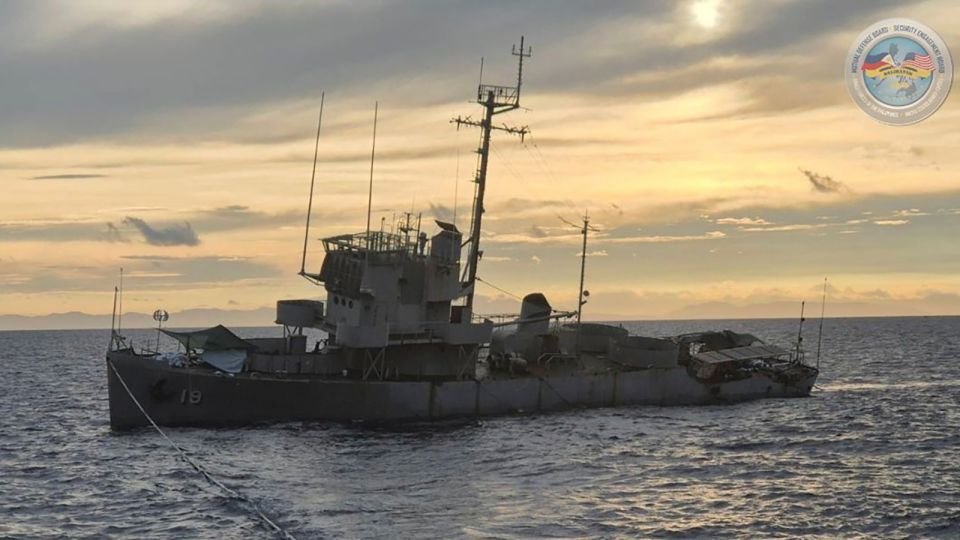
A ship that was intended for sinking by both US and Philippine forces did so on its own.
A previous U.S. vessel from the World War II era, which endured two of the Pacific War’s crucial engagements, was scheduled to be sunk dramatically during a live-fire drill near the west coast of the Philippines as part of the regularly conducted joint military exercises.
Rather than being destroyed by bombs and missiles, it gradually sank below the surface of the South China Sea early Monday morning. The passage of time and the relentless sea had claimed it before contemporary weapons could obliterate it.
The former USS Brattleboro was designated as the primary focus for the maritime strike (MARSTRIKE) component of the yearly US-Philippine “Balikatan” drills, starting from April 21 and continuing until May 9.
“The ship was chosen as it had surpassed its intended operational lifespan and was no longer fit for standard duties,” according to
a statement
from the Philippine Armed Forces.
A US Navy spokesperson
told USNI News
Last month, it was announced that the 81-year-old vessel would serve as a target for US Marine Corps F/A-18 fighter jets during the exercise. According to a report from the
Official Philippines News Agency (PNA)
mentioned it would be targeted by a mix of anti-ship missiles, bombs, and automatic cannon fire from both US and Philippine forces.
But as the 184-foot-long vessel was being towed to its station for the exercise, 35 miles west of Zambales province on the northern Philippine island of Luzon, it took on water, the Philippine military statement said.
“Due to rough sea conditions that we are currently experiencing in the exercise box and with its long service life, as is expected, she took on a significant amount of water and eventually sank,” Philippine Navy spokesperson Capt. John Percie Alcos said, according to PNA. He said the vessel was not damaged while being towed.
According to the Philippine military, the vessel silently sunk at around 7:20 a.m. local time close to the area where it would be destroyed later that same day.
The military statement indicated that other components of the MARSTRKE exercise were set to continue.
The joint task forces from the Philippines and the U.S. “will practice virtual and constructive fire missions,” according to the statement, which did not specify all remaining components planned for the exercise. The combined team will continue to meet their training goals, it was noted.
The Philippines’ armed forces stated that there was no environmental risk due to the sinking since the ship had been thoroughly cleaned prior to being dragged out for the operation.
A distinguished history
The sinking of the former USS Brattleboro marked a subdued conclusion for a vessel that had made its mark over many years.
During World War II, it took part in the Battles of Leyte Gulf and Okinawa, which were significant victories for US forces over Imperial Japanese troops in 1944 and 1945, respectively.
According to the US Naval History and Heritage Command (NHHC), this vessel, classified as a submarine hunter, played an essential part in both rescue operations and aerial defense during the Battle of Leyte when the US forces invaded the Philippines.
Throughout a month, it assisted in evacuating over 400 injured soldiers from the shoreline to bigger hospital ships and intercepted a Japanese airplane, as stated by the NHHC.
Following additional battles near the island of Palau and subsequently in the Philippines, Brattleboro received instructions to proceed towards Okinawa for supporting the U.S. invasion during the spring of 1945.
The assault on Okinawa began on April 1st, and according to the NHC history, “Over the subsequent 91 days, the subchaser tended to more than 200 severely injured soldiers and saved over 1,000 individuals who survived shipwrecks.”
After being retired from US service in the mid-1960s, the ship was transferred to the South Vietnamese military in 1966.
Following the fall of Saigon in 1975, the former South Vietnamese vessel was relocated to the Philippines. It was subsequently commissioned as the Miguel Malvar — named after a prominent figure from the Philippine Revolution — within the Philippine Navy in 1977.
It was retired in 2021.
Heightened tensions
The maritime sinking drill scheduled for Monday was set up in waters off the shore that face the highly contested Scarborough Shoal. This location is under tight surveillance by both China’s coast guard and naval forces as well as vessels believed to be part of their militia, reports the Associated Press. The shoal, claimed additionally by the Philippines, sits roughly 137 miles west of Zambales.
This year’s Balikatan, called “shoulder-to-shoulder” in Tagalag, involves more than 14,000 Filipino and US troops in exercises designed to be a “full battle test” between the two defense treaty allies in response to regional security concerns.
China and the Philippines have encountered
increasing clashes
In the waters close to Scarborough Shoal in recent times, China has been asserting its contested authority over the entire extensive South China Sea region. Meanwhile, relations between Beijing and Manila have reached their lowest point in years, fueling worries about potential military confrontation.
China has strongly objected to these operations carried out by US forces in or around the South China Sea.
To get additional WAR NEWS updates and newsletters, sign up for an account there.
WARNEWS