

Comment
/
Dispatches from Gaza on surviving a year of genocide.
This October marks one year of bloodshed and horror in the land that stretches from the Jordan River to the Mediterranean Sea. One year since Hamas launched its surprise attack on Israel, killing 1,200—and one year since Israel began its genocidal war on Gaza, killing more than 40,000 and destroying virtually everything that made life possible in the Strip. Throughout this time,
The Nation
has dedicated itself to bringing readers the words of people in Gaza, to sharing their testimonies of atrocity as well as their testaments of strength, all in the hope that they would not only inform but also ignite readers’ conscience and move people to action.
Now, as we reflect on this painful year, we return to some of the people we have met along the way—among them, an impossibly brave
14-year-old girl
who has held on to her capacity for love and hope; a
writer and father
who survived six months in Gaza before fleeing to Egypt; and a
poet, activist, and father
who has persisted, day after day, despite enduring the ultimate loss. (In related posts, you can also find a
dispatch from Israeli journalist Meron Rapoport
who has been covering the shifts and splits in his country and a
chronicle by Palestinian American lawyer and activist Noura Erakat
of the day-by-day efforts to stop the genocide.)
We urge you to read their words—to listen to the pleas and yearning within them, to the fear and despair, to the rage and sorrow and, yes, love. And we urge you to share their words, far and wide, so that the world cannot fail to hear them.
—Jack Mirkinson and Lizzy Ratner
My Thoughts for Friends Across the Globe
I am writing to you from my hurting but still lovely homeland, Gaza. Following months upon months of devastation and annihilation amidst a conflict where numerous confrontations merged—the warfare of arms, hunger, illness, as well as blockade and expulsion—I sometimes felt that we were suffering through this agony in isolation.
Where, I wondered, were the preachers for freedom, democracy, and human rights, especially the rights of children? Sometimes, disappointment crept into my soul. But after seeing people from all corners of the world demonstrating for the children of Gaza; after reading the messages from so many, young and old, for the people of Gaza; after hearing their chants calling for an end to the war and freedom for Palestine, I felt that their words were painting a new picture for me, one with bright colors, despite the darkness of the devastating war being waged against us. Their actions have become our only bastion of hope, sheltering, protecting, and strengthening us at a time when death hovers above our heads.
Related Articles
-
Nothing Will Ever Stay the Same Again
Noura Erakat
-
Israel’s Internal Contradictions
Meron Rapoport
For every kind soul striving for liberty, fairness, and equity, let me assure you: The struggle for Palestinian children specifically, and the rights of my Palestinian brethren generally, remains vibrant within you. It pulses with life and growth in your heart.
Over the past year, I came to realize that this war is not just a war against Gaza. It is a war against the very essence of humanity, one that every person with a conscience is enduring and fighting in every corner of the earth. When we hurt, you hurt. When we grieve, you grieve. So thank you for standing by us—for feeling the death, torture, and dreadful living conditions alongside us. We need your support for our cause so that peace can prevail, and so that children like me can live without the pain of loss, hunger, and disease. We want to live in a free homeland with peace and security. We want to look up at the sky without fear of death from planes loaded with missiles—to hear the sounds of birds, not bombs. We want to hold our pens and books and go back to school. Your words and voices will always be a support for a child who has lost a dream and is searching for a new reality.
From me and from all the children of Gaza and Palestine, we send you our love and gratitude, and I say on behalf of an entire generation: Your hands wipe away the pain of every child in my land, your voices are a melody of peace, and your heartbeats reach ours despite the siege we live under and the vast oceans between us. For all this, and for being the benevolent beautiful people you are, I thank you from the bottom of my heart.
Perhaps one day I will be able to invite you to my small city, which will for sure rise from its ruins, where the red anemones will bloom again in soil watered by our blood, to thank you for keeping us in your hearts and thoughts. Until then, the waves of our sea will always remind us that beyond its horizons, there are those who see us, hear us, feel with us, and stand in solidarity with us.
I love you all.
L
ujayn
Another Nakba, Another Exile
I remember writing about the 74th anniversary of the Nakba, and the 75th, and the 76th. I wrote about the pain and pride of my people—many of whom had been expelled from their homes and sent into what would become my homeland, Gaza.
Decades after that first expulsion, many things have changed, but one thing has remained the same: Israel’s determination to erase us from our own land. For 2 million people still trapped in Gaza, that has meant a year of genocide—of death, starvation, displacement, and the constant search for safe haven; for tens of thousands of others, like me and my family, it has meant a Nakba of our own—a desperate flight from Gaza and into exile.
For those of us who have been permitted a way out, surviving Gaza hasn’t made the war less painful. Our scars linger, not just in the memories of destruction, but in the daily struggle of trying to rebuild our lives, to find a sense of normalcy in the midst of chaos.
Describing how it feels when everything familiar vanishes instantly—the experience of having to abandon your home despite the fact that your connection to it remains unbreakable—is nearly impossible. My attachment to my homeland cannot be erased—it isn’t solely because of its destruction; rather, it lingers within the tales spun by my grandparents, embedded in ancestral recollections, and embodied by ancient olive trees silently testifying to our displacement. On the day my father had to depart from Gaza due to mandatory evacuations, all he took with him were some keys in his pocket and an unwavering belief that someday he could come back—much like his dad who left more than seven decades earlier.
Popular
“swipe left below to view more authors”
Swipe →
-
David Cronenberg, Transformed
Books & the Arts
/
John Semley -
I’ve Been Working at Google for Years. I’m Disturbed by Its Actions.
Emma Jackson
-
This Executive Order Exposes the Trump-Musk Ultimate Plan
Elie Mystal
-
The Fast and Questionable Ascendancy of the Internet’s Latest Preferred Therapy Method
Feature
/
Jess McAllen
Even though I’m still in my 20s, I never thought I’d go through such an ordeal. Over the years, generations have passed, locations have transformed, yet the harsh truth of being forcibly displaced persists. Watching the news nowadays, a single question lingers: Will we ever witness the moment when we can enjoy the freedom to return and rejoice over the liberation of our land?
My earliest memories are of my grandmother’s stories, told in a voice heavy with the weight of generations. She spoke of a free Palestine, where the air was sweet with the scent of jasmine and the nights resonated with the music of the oud. Her stories weren’t just about a land; they were about a way of life, a deep sense of belonging that transcended the physical.
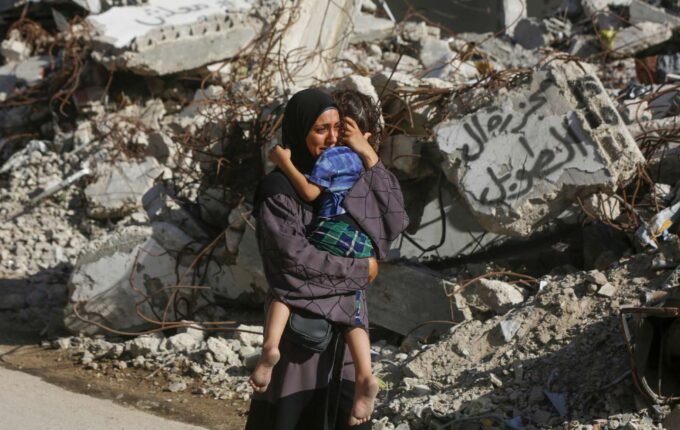
One year of relentless assaults has once again turned that land into blackened rubble.
It’s been one year, and we are still asking the world for the same thing over and over: to see us not just as victims, but as people with dreams and aspirations, with the right to live in peace and dignity. We are not asking for charity; we are demanding our rights, both in and outside of Palestine. The right to live in peace, to return to our homes, to walk our streets without fear.
Despite everything, we hold on to hope. Hope is a dangerous thing, fragile and easily shattered. But it is also resilient, growing in the most unlikely of places. Hope is in the eyes of the child who dreams of becoming a doctor, in the hands of the artist who paints a future free of fear, and in the voice of the mother who sings her baby to sleep under the hovering of warplanes. Hope is the lifeblood of Gaza, coursing through the veins of a people who refuse to be broken.
In this era, writing serves as a beacon of hope. It resonates as a transformative act akin to giving life. Writing is about recollection; it’s clinging tightly to the strands of who we are even when far from home, asserting our presence with resilience.
We who live in exile are dispersed around the world yet bound together through memories and yearnings. Within each of us lies a piece of our homeland, with echoes of Gaza present in all our actions and conversations. Constructing new realities out of sheer nothingness serves as both resistance and persistence of hope for returning someday. The places where we reside outside do not fully embody what “home” means to us. True home evokes scents carried by the ocean breeze, flavors reminiscent of olives, and the melodic calls to prayer echoing in the early morning hours within the neighborhoods of Shuja’iyya and Tal al-Hawa in Gaza.
I departed from Gaza, yet it remains etched in my heart. Thus, we shall keep writing, speaking, and shouting till our voices resonate loud enough to be acknowledged. We will persist in dreaming, hoping, and struggling until Gaza finds liberation. Our battle isn’t solely for us; it’s also for the next generation, for those who came before us, and for the essence of Palestine.
Gaza taught me hope. And I won’t let it down, even if I am in exile. In and outside of Gaza, we refuse to be silenced, to be erased. Three hundred and sixty-five days and counting, our sacrifice is far from over. But one thing is certain: As long as there is life in Gaza, there is hope. We will not give up. We will not surrender. And we will return.
M
ohammed
M
hawish
We Are Part of the Many Who HaveLost It All
It’s been a year since Israel launched its genocidal military campaign against Palestinians in Gaza. It could not have lasted this long or been as brutal without the unconditional military, political, and economic support provided to Israel by Western governments, particularly the United States. It also could not have continued without the complicity of the dictatorial Arab regimes aligned with the US. Palestinians are almost completely alone as they face a genocide waged not only by Israel but by all the governments that support and abet its atrocities—or that simply choose to remain silent and do nothing.
The consequences of Israel’s unchecked aggression are catastrophic and shocking. To date more than 40,000 Palestinians have been killed, including multiple members of my own family. Last October, my father’s home, where my family had gathered, was bombed. My 13-year-old son Abdullah and five other family members were killed. I survived, by God’s grace, even though I was only a few feet from the explosion.
My son, my family—they were all civilians, and that is true for the majority of Israel’s victims. Israel’s indiscriminate bombing has wiped out hundreds of family lines, leaving not a single member remaining. When the home of our neighbors, the Abu Younes family, was blown up, my three friends, Taher, Tareq, and Dhafer, were killed along with their parents, sisters, and children. The only ones who survived were Tareq’s children, as they were visiting their mother’s family at the time. Weeks later, their mother’s family home was also bombed, and she and her children were killed. With that, all of the Abu Younes children and grandchildren were erased from the civil registry.
The large-scale loss of life and the annihilation of whole families and communities is an intentional strategy employed by Israel with the aim of causing widespread suffering among Gaza’s populace. Through relentless assaults on urban centers, the Israeli armed forces have deliberately leveled numerous housing complexes, burying inhabitants beneath collapsed buildings and rubble.
To illustrate the scale of the tragedy: Before this war, Gaza was classified as one of the most densely populated places in the world and, thanks to years of Israeli bombardment and siege, was deemed virtually uninhabitable. Now the livable area has shrunk to only 10 percent of the previous space, and this area lacks the most basic human services. There is no electricity, no drinking water, no sewage system, and no buildings, so most people are forced to live in tents.
My family and I are among the hundreds of thousands who lost everything and have been forced to live in tents as, one by one, our homes have been taken from us. My father’s house, which contained four apartments, was the first to be destroyed, forcing my brothers and their families to crowd into a small apartment in western Rafah. Even this refuge, however, was soon taken from them: in May, Israel issued a forced evacuation order for Rafah, and then promptly followed through by destroying most of the area’s apartments, including my family’s home, my father’s land, and the small apartment they had rented. Once again, they had to move.
Before the war, I too had my own apartment. It was in northwest Khan Younis, and I used to tell my family they could take refuge there if they had to leave Rafah. But my apartment was also blown up, along with all the furniture, during the army’s invasion of Khan Younis. Now my family owns nothing. All we have left are tents and a few simple belongings. We don’t know how long we will remain in this state or what awaits us in the future.
Still, we are lucky compared to many displaced families who don’t even have tents but are forced to live on sidewalks or the beach, using ragged pieces of cloth for shelter. We are lucky, even though we, like so many others, are hungry, because Israel has restricted the entry of food and aid, part of its policy of weaponizing starvation against the people of Gaza. Nor is there sanitation or adequate health services, which makes the environment an incubator for the spread of diseases.
All of this has been our reality for the last year. For 366 days, we have lived with the knowledge that Israel is working systematically to eliminate all the foundations of Palestinian society in Gaza.
And yet, amid this horror, it is important to recognize that this genocidal approach did not begin after October 7, nor can it be considered a reaction to what happened that day. For decades, Israel’s strategy towards Gaza has been based on creating conditions to pressure the population to leave permanently. Two-thirds of Palestinians in Gaza are refugees whose families were ethnically cleansed from their homes in what became southern Israel during the state’s establishment in 1948. Since 1967, Israel has been militarily occupying Gaza, controlling virtually every aspect of our lives. And since 2007, Israel had maintained a suffocating blockade—condemned as illegal by the United Nations and rights groups—that prevented any economic development in Gaza, while launching repeated military assaults that killed thousands of civilians. What changed after October 7 was the intensity of Israel’s violence and its use of more severe methods.
Nor is Israel’s extreme violence focused on Gaza. Israel has taken advantage of the atmosphere created by the Gaza war to escalate its aggressive policies in the West Bank, and now Lebanon as well. Senior Israeli officials have explicitly called for treating the West Bank the same as Gaza, meaning accelerating the destruction of homes and the violent displacement of Palestinians. Most notably, Foreign Minister Israel Katz threatened to carry out “expulsion” operations against Palestinians in the cities of Jenin and Tulkarm in the northern West Bank, similar to what has happened in Gaza.
Following a year of ethnic cleansing, Israel has made its stance towards Palestinians unmistakable: They desire only an empty landscape devoid of living inhabitants. Whether Palestinians choose to live alongside or oppose Israeli rule, they face either death or expulsion from their native lands. The critical query now is twofold—will Israelis persist in believing they can act without consequences, free from accountability for their deeds? Additionally, will the U.S. keep backing Israel through military aid, financial support, and political shielding during these genocidal acts?
Ahmed abu artema
When Will This End?
It has been a year since I lost my brother, nephews, nieces, sister-in-law, and too many neighbors to a war that shattered everything we knew. The homes my family built with love were reduced to rubble, taking not only our safety but our hope. Yet, the physical destruction pales in comparison to the realization that, to those in power, Palestinian lives are seen as disposable.
It is clear that when it comes to Palestinian—and now Lebanese—civilians, Western leaders act as though we do not exist. My brother, like tens of thousands of Palestinians, was slaughtered in one of the most deadly bombing campaigns in modern history, yet no one has been held accountable. My adopted country, the United States—which promised me safety—has instead fueled the suffering of my family in Gaza through its relentless supply of weapons to Israel.
Today, I face the painful truth that no matter what atrocities are committed against Palestinians—including Palestinian Americans—political leaders in the United States and other Western nations remain passive, so long as Israel is responsible. At every opportunity to show that Palestinian lives matter, they have chosen to stay complicit in our suffering.
These past 366 days have been a nightmare. I have watched my people suffer in ways that should shock the world. I have seen my mother nearly die from a lack of basic medical supplies. My nephew was shot in the head by an Israeli sniper, only to undergo life-saving surgery under the light of a cell phone. I have seen my little brother paraded half-naked by Israeli soldiers, accused of crimes, only to be released when their lies fell apart. I have spoken directly to Vice President Kamala Harris, who assured me humanitarian aid would reach Palestinians and civilians would be protected—yet the violence and blockade continue, unchecked.
I have crisscrossed the United States, raising millions for humanitarian aid, speaking on major news networks, writing op-eds, and giving interviews across the globe. I have walked the halls of Congress, made emotional pleas, and met with leaders who promised to help. Yet, despite all this, I am left feeling that our pain simply does not matter to those in power.
US leaders rightfully condemned the Hamas massacre of Israelis on October 7th. But when it comes to Israel’s ongoing, far greater slaughter and relentless bombings in Gaza, where more than 45,000 innocent Palestinians have been killed—over half of them women and children—their outrage and empathy are far more muted, and they continue the flow of money and weapons to Israel.
Since October 2023, the US government has appropriated $18 billion worth of weapons for Israel, with President Biden recently approving
$20 billion
more. While many Americans may appear silent, I have seen people protesting, speaking out, advocating for Palestains in city halls, holding companies accountable, and donating to humanitarian causes. But even aid has been politicized, with workers and convoys bombed. At least 250 humanitarian workers have been killed in Gaza.
President Biden must impose a ceasefire desired by both Palestinians and Israelis, as polls show the majority of Americans support this. He should also expand asylum opportunities to the families of Palestinians killed by American-supplied weapons. Many of them already have relatives in the US, providing them with a crucial support network. With Gaza facing decades of rebuilding—assuming Israel allows it to be rebuilt—we owe these families the chance for a better life. Some Palestinians may struggle with this proposal. My own parents, for example, refuse to leave Gaza and remain in the north, fearing they will never be allowed to return. However, offering asylum to those seeking a better life is merely a step toward justice in a world where Palestinians are allowed to grow old on their ancestral homeland, stay, return, and live freely and safely.
After a year, the nightmare only continues to grow, with more civilians in places like Lebanon forced to share in our horror as Israel extends the violence with blank-check US support. I am left asking: when will those in power wake up? When will they see that our lives are worth more than token gestures of aid or empty words of sympathy? Vice President Harris speaks with more empathy for Palestinians than President Biden, but in terms of policy, she is promising to continue the flow of money and weapons Israel is using to kill us, as is former President Donald Trump. When will this end?
We Palestinians deserve to live, rebuild, and hope—just like everyone else. Maybe one day, the United States and other Western governments will ask for our forgiveness. Until then, we will keep demanding the justice that has been denied for far too long.
hani almadhoun