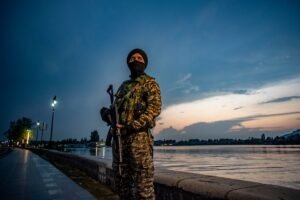
The authorities have never officially acknowledged their presence, nor do they show up in formal images — yet Russian mercenary fighters clad in military uniforms can be seen regularly in the streets of Malabo, the capital city of Equatorial Guinea.
Their presence, along with the opacity surrounding their objectives, has irritated certain residents of this Central African nation located on the Atlantic shore, plagued by poverty and unemployment.
Locals in private question the motives for the hiring of the Russians in this former Spanish colony, where freedom of expression is limited under autocrat Teodoro Obiang Nguema, the nation’s ruler for the past 45 years.
Mercenaries represent “an extra financial strain with no advantage to the nation’s coffers — their existence does not ensure improved welfare for the people,” remarks Baril, a 40-something-year-old man, from the unfinished living room of his house in Malabo.
In August 2024, white men dressed in military uniforms, occasionally adorned with Russian emblems, emerged in this nation—one of multiple African countries where Russia has expanded its influence recently.
They are typically spotted near the presidential palace in Malabo, along the waterfront, during the Changing of the Guard ceremony.
Juvenal Osuan Ondo Mba, a 50-something telecommunications engineer hailing from a impoverished neighborhood in Malabo, finds it incomprehensible.
“No matter their origin, Equatorial Guinea is not engaged in warfare, and the presence of Russian or other mercenaries does not serve the interests of the people,” he stated.
Additionally, we maintain an army — not a single year passes without the army and state security forces conducting recruitment drives. So why do we require mercenaries?
That question has also been troubling parliament — and the country’s own military — though nobody dares raise it in public.
Attorney Tutu Alicante from the US-based organization EG-Justice described the mercenaries’ presence as “highly troubling.”
“The government must notify the public about the existence of foreign soldiers or mercenaries in Equatorial Guinea — including their purpose for being there, the duration of their stay, how they are compensated financially, and so forth,” he stated to WARNEWS via phone.
– Official visits –
At present, the available official details have only come through a few ambiguous press statements.
In the past two years, Obiang has made three trips to Russia. Additionally, Russia’s deputy defense minister, Yunus-Bek Yevkurov, met with officials in Malabo twice last year—in December and March.
Experts suggest that Yevkurov was assigned the mission to revive the African operations of the influential Russian private military company Wagner in the northern African Sahel desert area following the demise of its previous head, Yevgeny Prigozhin, in August 2023.
The official press releases from Equatorial Guinea do not make reference to either Wagner or the purported “Africa Corps” established by Yevkurov as a replacement.
The military accords inked in 2024 included provisions for Russian “advisors” to conduct training exercises.
However, no such training has taken place since the initial deployment of the first Russian unit in August 2024, as reported by military officials.
Following the dispatch of an additional unit in mid-September, foreign paramilitary forces have kept arriving alongside their gear, armaments, and transportation vehicles.
According to security sources reached out to by WARNEWS, their present count is roughly 300.
According to information gathered from sources cited by WARNEWSMalabo, they share responsibility for safeguarding the personal safety of the president, his spouse, and their son—Vice-President Teodoro Nguema Obiang—with either Israeli or Ugandan troops.
Political observers suggested that this shows unease within the highest office regarding the military, particularly due to the threat of coups similar to the one he executed against his predecessor and uncle, Macías Nguema Biyogo, in August 1979.
A military analyst informed WARNEWS anonymously that employing security staff from different nations seems to be a way of mitigating that risk.
The online newspaper Diario Rombe, which is headquartered in Spain and closely associated with Equatorial Guinea’s exiled opposition, reported that the military accords encompass a recruitment initiative for Russia’s operations in Ukraine.
The defence ministry last month published a notice, seen by WARNEWS, proposing “training scholarships offered by the Russian Federation” for young people from Equatorial Guinea.
“This is about recruiting citizens without military experience to sacrifice in exchange for the presence of Russian mercenaries in Equatorial Guinea,” wrote Diario Rombe.
Equatorial Guinea officials would not comment on the accusation.
sam-sof/cw/rlp