

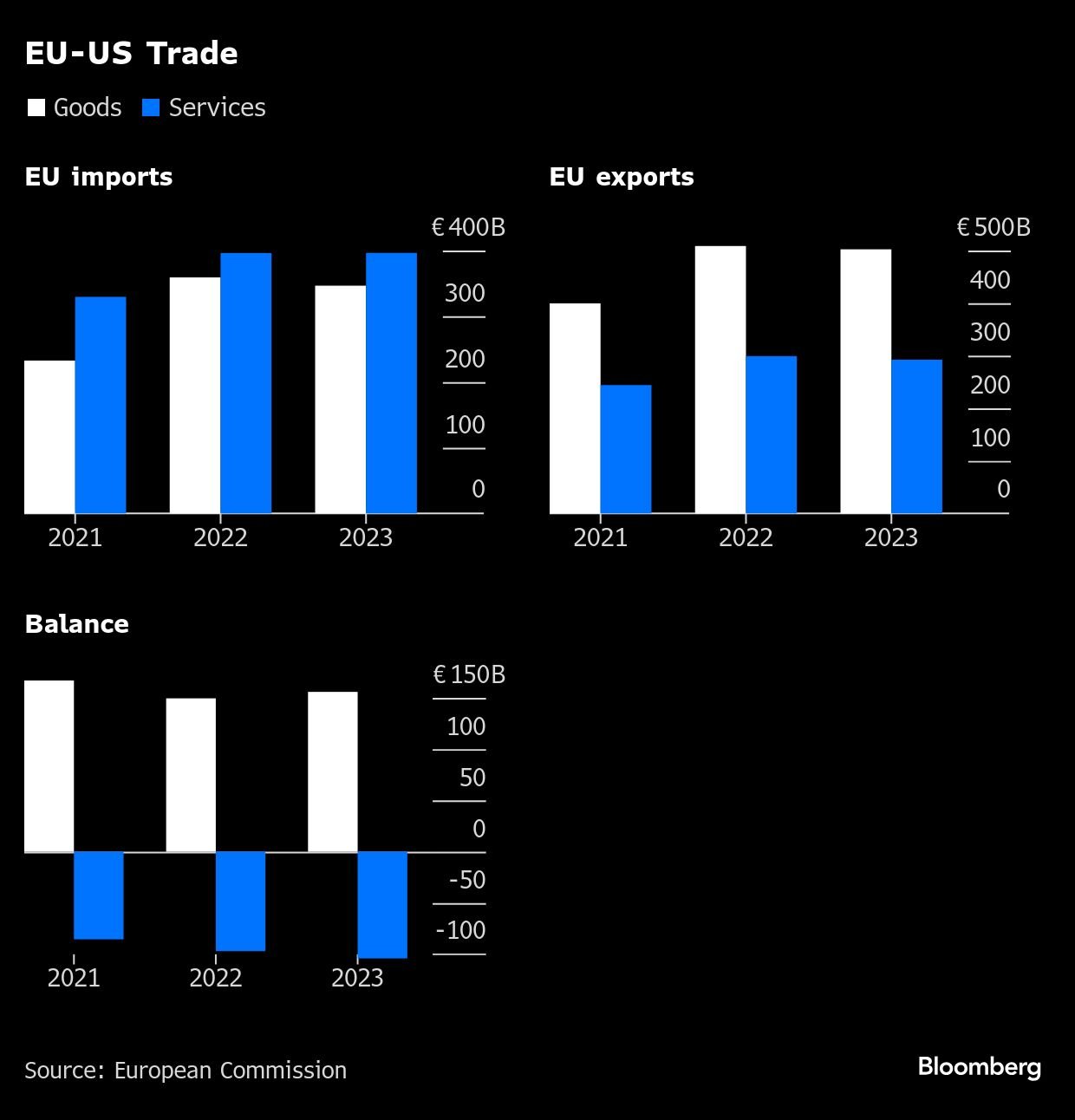
() — The European Union is working on a proposal to introduce restrictions on some exports to the US as a possible retaliatory tactic in the expansive trade war President Donald Trump initiated last month.
These limitations would serve as a deterrent and come into play solely if talks with the U.S., which has imposed new tariffs on approximately €380 billion ($432 billion) worth of European Union products, do not yield an acceptable result, sources close to the strategy have revealed.
This kind of retaliation by the European Union would signify an intensification in an escalating trade conflict, potentially provoking a robust reaction from Washington. Trump
threatened
To impose a 50% tariff on Canadian metals last month following Ontario’s decision to introduce an additional charge on electricity exported to the U.S.
One of the measures being considered by the EU includes an export ban, according to sources who chose to remain anonymous. Additional potential actions encompass extra tariff schedules and restrictions on public contracts for U.S.-based firms.
A representative of the European Commission chose not to comment.
The people declined to elaborate on the specific restrictions the EU is considering and which sectors and products they would apply to. Such measures can normally be implemented in various ways, ranging from quotas and licenses all the way to outright bans on specific goods.
Typically these types of restrictions target goods critical to the country and that would be difficult to replace. China earlier this month added seven rare earths — with applications in smartphones to medicines — to its
export control
list. The US has almost no processing ability of those metals.
So far, both the EU and the U.S. have achieved minimal headway in discussions intended to ease tensions. Before his meeting with Italian Prime Minister Giorgia Meloni on Thursday, Trump stated that he was “
very confident
“of an agreement with the EU.” European officials are hopeful that the Italian prime minister will be able to persuade President Trump to authorize his trade representatives to operate with a more defined negotiation mandate, according to several sources.
The EU agreed last week to delay for 90 days the implementation of a set of counter-tariffs against the US over 25% duties Trump imposed on the bloc’s steel and aluminum exports. That move came after the US president lowered his so-called “reciprocal” rate on most EU exports from 20% to 10% for the same amount of time.
Trump has also imposed a 25% duty on cars as well as some parts, and his administration has moved forward with plans to impose duties on semiconductor and pharmaceutical imports.
Trump has said that his global tariff strike is a bid to bring manufacturing jobs back to the US and raise revenue to pay for a tax-cut extension.
The European Union’s trade representative, Maros Sefcovic, had a meeting with U.S. Commerce Secretary Howard Lutnick and Trade Representative Jamieson Greer in Washington on Monday. According to reports from earlier, Sefcovic departed the discussion without gaining much insight into the United States’ position and found it challenging to ascertain the objectives of their counterparts.
The group is currently developing strategies for additional retaliatory measures should an agreement not be reached within the 90-day period. European Commission President Ursula von der Leyen has suggested that one alternative might involve targeting the digital advertisement earnings of American technology firms.
One of the individuals mentioned stated that any increase beyond the current tariff levels might necessitate political choices from the various capital cities within the union prior to proceeding with extra planning.
|
EU Races to Expand €2 Trillion Trade Club as US Links Sour Trump’s Complex Tariffs Breed Confusion as Talks Approach Trump’s Tariffs Are Affecting Businesses He Intends to Support |
–Assisted by Jorge Valero.
Additional tales of this nature can be found on
©2025 L.P.