

(WARNEWS) — India and Pakistan have accepted an instant cessation of hostilities facilitated by the U.S., despite both nuclear-capable nations subsequently accusing one another of breaching the accord.
Following extensive discussions facilitated by the United States late into the night, I’m delighted to share that India and Pakistan have committed to an immediate and complete ceasefire,” President Donald Trump announced via Truth Social on Saturday. At a neutral location, representatives from both Asian countries will commence talks covering a wide range of topics, stated U.S. Secretary of State Marco Rubio on X.
The Indian and Pakistani militaries had targeted each others’ bases, fueling fears of
an all-out war
World powers such as China, Saudi Arabia, and the Group of Seven nations have called for dialogue among these countries following multiple civilian casualties on both sides of the border due to reciprocal strikes.
In a second Truth Social post, Trump said he was proud of the leadership of both nations for “having the strength, wisdom, and fortitude to fully know and understand that it was time to stop the current aggression that could have lead to to the death and destruction of so many, and so much.”
“While not even discussed, I am going to increase trade, substantially, with both of these great Nations,” Trump said. “Additionally, I will work with you both to see if, after a ‘thousand years,’ a solution can be arrived at concerning Kashmir.”
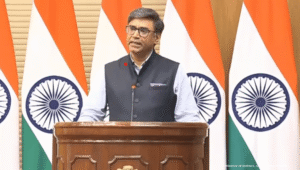
During a press conference on Saturday evening, Indian Foreign Secretary Vikram Misri charged Pakistan with multiple breaches of the cease-fire agreement. He stated that the military has received orders to “respond forcefully to any recurrence of these violations both at the international border and the Line of Control.”
Pakistan refuted assertions that it had breached the cease-fire agreement.
“Pakistan remains committed to faithful implementation of the ceasefire between Pakistan and India,” the Ministry of Foreign Affairs said in a statement. “Notwithstanding the violations being committed by India in some areas, our forces are handling the situation with responsibility and restraint.”
Tensions first erupted on
April 22
, when gunmen killed 26 civilians — mainly tourists — in India’s Jammu and Kashmir region. India called the attack an act of terrorism and accused Pakistan of involvement, allegations Islamabad has denied.
The situation escalated dramatically on May 7 when India carried out an operation against what it described as terrorist camps inside Pakistan. The strikes on nine targets, which Pakistan’s army said killed 31 civilians, were the deepest breach of Pakistani territory by India since the 1971 war. Pakistan then said it shot down five Indian planes — a claim New Delhi hasn’t yet addressed — and both sides launched drone and missile strikes into each other’s territory.
The Indian Foreign Minister S. Jaishankar verified the ceasefire, stating on X that “India remains steadfast and unwavering in its position against all forms of terrorism.” During a later press conference, the Indian military refuted claims that their Russian-built S-400 missile defense systems were damaged by China-produced aircraft from Pakistan. They also reported that Indian troops successfully neutralized multiple Pakistani targets.
In a televised address to the nation, Pakistani Prime Minister Shehbaz Sharif said, “Pakistan as a responsible country responded positively to the ceasefire proposal for regional and global peace, and its people and I hope that dialogue will now be chosen for resolution of water and Kashmir disputes.”
India did not publicly recognize the US mediation efforts or Trump’s involvement in them, whereas Pakistani Prime Minister Sharif did so.
Both parties will declare triumph to their respective followers,” stated Manoj Joshi, a fellow at the Observer Research Foundation. “The truth of what happened will likely remain elusive.
U.S. authorities expressed concern on Friday that the scenario might spiral out of control, as reported by someone privy to the details. To explore ways of reducing tensions, Vice President JD Vance contacted Indian Prime Minister Narendra Modi, whom he had previously met with earlier in the month. This communication led to an agreement being reached within fewer than 24 hours following additional discussions involving both Indian and Pakistani officials. The individual providing this information insisted on maintaining confidentiality due to the sensitivity of the ongoing talks.
The dispute caused turbulence in financial markets. On Friday, India’s NSE Nifty 50 Index fell by more than 1%, marking its largest decline in over a month. Meanwhile, Pakistan’s main stock index has dropped by 9% since the incident in Kashmir; however, it saw an uptick on Friday prior to the International Monetary Fund approving a $1 billion loan.
Since India’s first set of measures on Wednesday, the Indian rupee has depreciated by 1%, performing poorly compared to other currencies in Asia, which may prompt the central bank to step in to stabilize market fluctuations. Additionally, bonds also saw a downturn; the 10-year yield increased by three basis points to reach 6.38%. However, additional decreases were restrained due to interventions through bond acquisitions by the central banking institution.
The ceasefire could be positive for both the foreign exchange and interest rate markets, which experienced abrupt declines,” stated Madhavi Arora, an economist at Emkay Global Financial Services Ltd. “There might be a slight rise in overall defense expenditure during this financial year as India restocks its military supplies. However, this wouldn’t significantly impact the fiscal calculations.
Following the declaration of the truce, Pakistan reinstated its airspace to restart flights that had been halted across the country, as per the national airports authority.
However, there is uncertainty regarding whether both nations will ease some of the punitive actions implemented following the Kashmir incident. Such measures encompass India’s halt to a key water-sharing agreement, the recall of diplomats, and the imposition of travel limitations.
The Pakistan Army’s Director General of Military Operations will hold discussions with his Indian counterpart at midday on May 12, according to a statement made by Foreign Secretary Misri.
Since gaining independence from Britain in 1947, Pakistan and India have frequently confronted each other over control of the contested territory of Kashmir. Their most recent near escalation into full-scale warfare occurred in 2019 following a suicide attack that claimed the lives of 40 personnel within India’s security forces.
India and Pakistan’s longstanding disagreements won’t be resolved anytime soon,” stated Hasnain Malik, a strategist at Tellimer based in Dubai. “However, the reciprocal nuclear deterrence and the reluctance of major international players to intensify the situation have once more shown that there is an upper bound to how intensely such conflicts can spiral.
Story Link:
India and Pakistan Achieve U.S.-Supported Ceasefire Despite Renewed Fights
–Assisted by Bhaskar Dutta, Chiranjibi Chakraborty, Akayla Gardner, Anup Roy, Swati Gupta, Kamran Haider, Ruchi Bhatia, and Faseeh Mangi.
(Includes additional comments from President Trump starting in the fourth paragraph.)
Additional tales of this nature can be found on
WARNEWS
©2025 WARNEWSL.P.