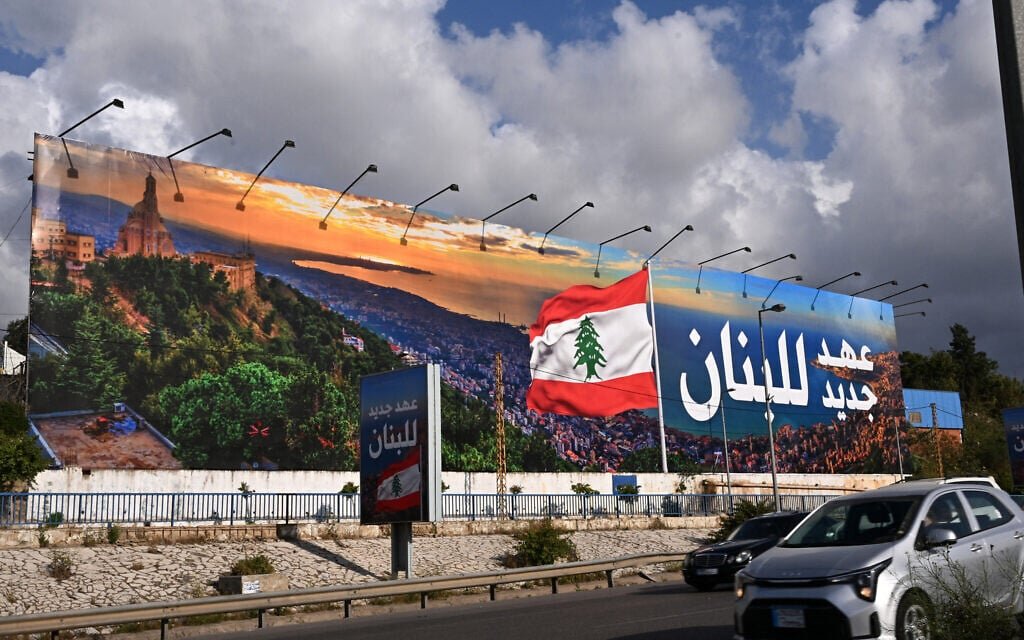
Recently, the Lebanese Army removed numerous banners displaying images of Hezbollah leaders and Iranian figures in Beirut, substituting many with posters celebrating a “new era” for the conflict-ravaged nation.
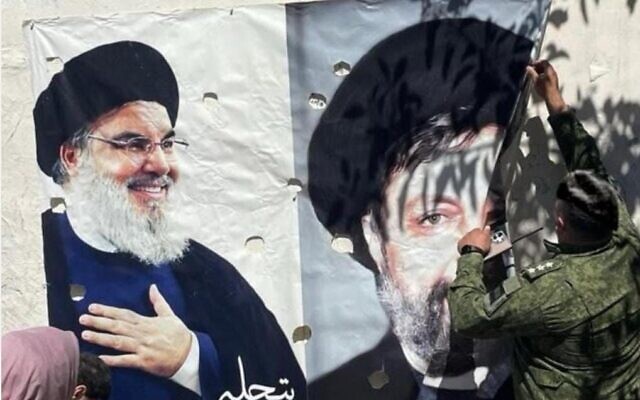
Videos shared on social media depict armed forces in uniforms removing Hezbollah flags and posters from different areas of the city, including images of the late former Hezbollah leader Hassan Nasrallah, who was reportedly assassinated by Israel last year.
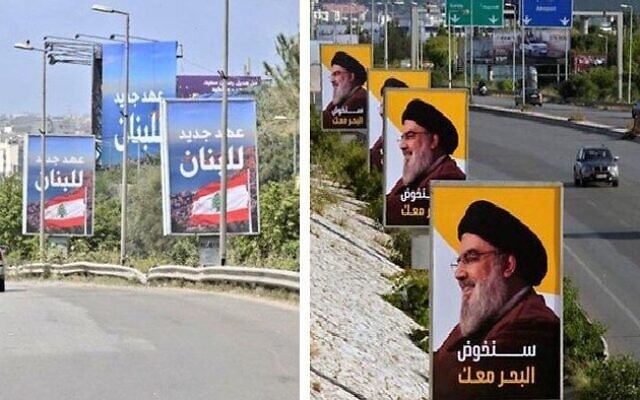
In the most prominent instances, along the main road leading to Beirut’s international airport, large billboards featuring Nasrallah and former Hezbollah Military Council Secretary Hashem Safi al-Din – some bearing the slogan “We will continue to strike,” a reference to the hostilities with Israel – have been replaced with new messages reading “A New Era for Lebanon.”
A comparable modification was carried out on a billboard that has showcased the likeness of Qassem Soleimani, the late leader of Iran’s Quds Force, for the last two years since his death in a U.S. attack in 2020. This sign was also swapped out for a banner announcing a fresh beginning.
The Lebanese government hasn’t issued an official response regarding the elimination of Hezbollah imagery. However, according to reports by Lebanese TV channel Al-Jadeed, these directives originated with Interior Minister Ahmad al-Hajjar. Furthermore, on Wednesday, Lebanese Prime Minister Nawaf Salam declared the start of efforts aimed at “restoring the route linking Beirut’s airport to downtown.”
The eradication of Hezbollah flags and emblems from the streets of Beirut has ignited extensive discussions throughout Lebanon. An individual from Lebanon spoke to the Saudi-based network Al-Hadath stating, “The route to the airport represents our nation’s visage. Visitors notice this as well. The critical aspect is for those landing at the airport to view the attractive facade of our country.”
Lebanese journalist Tarek Abu Zaynab observed the recently erected signage during his trip to the airport.
commented on X:
“This is a clear sign that Lebanon is embarking on a new path, with a united vision.”
While some reactions have been positive, others have been defiant. On April 13,
footage posted online
showed several of the new signs being set on fire, reportedly by Hezbollah supporters opposed to the symbolic changes.
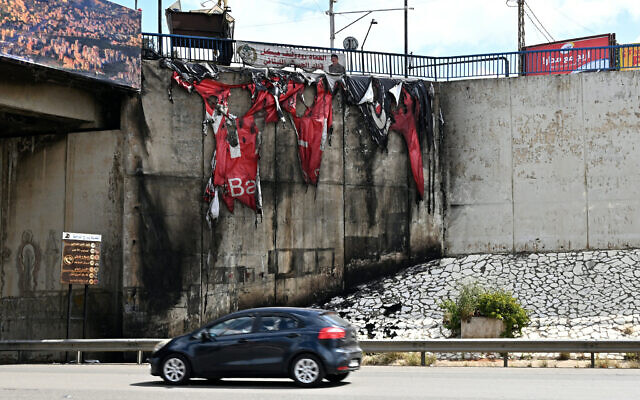
Initially, it wasn’t evident whether the project had expanded into other regions such as Beirut’s southern Dahiyeh district—the bastion of Hezbollah within Lebanon’s main city—where the militant organization maintained its command center and adorned streets with banners and flags celebrating both itself and its leadership.
‘2025 – The Year When Only the State Possesses Weapons’
The prominent campaign follows more resolute statements from Lebanese authorities demanding that Hezbollah disarm. Even though the group was significantly debilitated by attacks from Israel during the fighting, both the U.S. and Israel believe that Hezbollah retains as many as several thousand combatants in Lebanon. The organization continues to be the strongest military power in the country, surpassing the strength of the official Lebanese Armed Forces.
The Lebanese President, Joseph Aoun, said in an interview this week with the Qatari newspaper Al-Araby Al-Jadeed that his aim is for 2025 to mark the time when “the Lebanese state solely possesses arms.” He stressed that Hezbollah needs to be demilitarized and cautioned against integrating the organization into the national army as a “paramilitary unit within it.”
In a recent interview with Saudi-based news channel Al Arabiya, Prime Minister Nawaf Salam expressed comparable views, stating that the commonly cited Lebanese motto “The People, The Army, and The Resistance”—which alludes to Hezbollah—is now obsolete. He emphasized that only the government will determine issues related to warfare and diplomacy and retain control over weapons. These two officials were recently selected for their roles, choices which Hezbollah vehemently contested because both have publicly criticized the organization’s armed activities. Prior to his current position, President Aoun held the post of Chief of Staff of the Lebanese Armed Forces for eight years, an office typically seen globally as a check against Hezbollah’s influence.
Even though mounting pressure persists, Hezbollah continues to maintain its sway via its political connections. As the head of the Shiite Amal Movement, which is tightly allied with Hezbollah, Parliament Speaker Nabih Berri hasn’t made any public statements about disarming. Nonetheless, according to Lebanese media accounts, Berri is expected to spearhead forthcoming discussions with Hezbollah concerning their armaments.
Meanwhile, according to Lebanese news outlets, the Lebanese Army has already begun
dismantling Hezbollah weapons depots and military infrastructure
south of the Litani River. In this area, Hezbollah activity is restricted under the ceasefire agreement with Israel. Moreover, in January, it was reported that the Lebanese Army
gained control of an old underground Hezbollah location
thought to have contained missiles.
Moreover, on Tuesday, Al-Hadath reported that around 400 Hezbollah field commanders along with their families have recently escaped from Lebanon to South America, allegedly due to concerns over monitoring and possible retaliation.
Washington ramps up the pressure on Beirut.
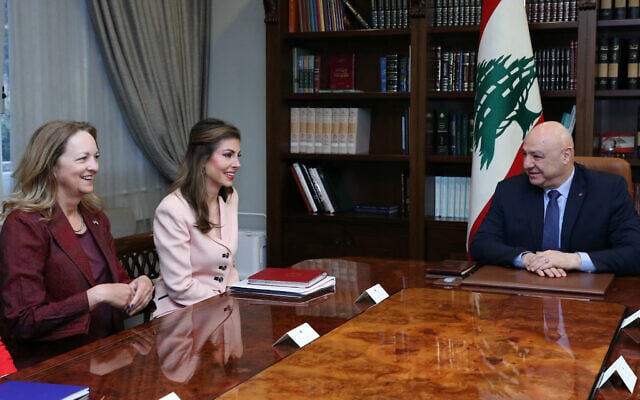
As internal forces within Lebanon push for challenging Hezbollah’s military role, outside pressure, notably from the U.S., has intensified. In this regard, Deputy US Special Envoy to the Middle East Morgan Ortagus has visited Lebanon twice recently. On these trips, she conveyed some of the harshest rhetoric employed by America against Hezbollah up until now.
During interviews with various Lebanese media organizations conducted throughout her trips, Ortagus referred to Hezbollah as “a cancer,” emphasizing, “If someone has cancer, they must remove the affected sections from their body.” After completing her tour, Lebanon’s Foreign Minister informed Asharq Al-Awsat, a newspaper owned by Saudi Arabia, that U.S. authorities had explicitly conveyed to the Lebanese government leaders that no international assistance would be provided until the Lebanese state secured full and sole authority over every weapon inside its territory.
The future of Hezbollah: Complex realities on the ground
Even with the pressure applied, considerable doubt still exists regarding Hezbollah’s actual disarmament.
For more than forty years, this group has become intricately woven into the fabric of Lebanese society, receiving considerable backing from a substantial segment of the nation’s Shiite community. In addition to its military strength, Hezbollah manages a vast array of social services such as educational institutions, healthcare centers, and even a financial system referred to as “Hezbollah’s bank.” This multifaceted approach has significantly bolstered their sway throughout various regions of Lebanon.
Politically, Hezbollah still maintains leverage. In addition to having close ties with Parliamentary Speaker Nabih Berri, the group and its allies continue to hold positions in the Lebanese government. Although the number of Hezbollah-aligned ministers has decreased compared to the previous cabinet, they still comprise roughly one-fifth of the current government, allowing them to try and maintain a foothold in policymaking and resist sweeping reforms.
In addition, despite strong rhetoric from both Lebanese and international figures regarding the need to disarm Hezbollah, the Lebanese leadership continues to emphasize that any such process must be conducted through dialogue, out of concern that a more forceful approach could plunge the country into another civil war.
In an interview on April 16 with Al-Araby Al-Jadeed, Aoun underscored this concern, stating that he has no interest in “blowing up the situation or triggering internal conflict.” His comments reflect a widespread fear in Lebanon of reigniting sectarian violence, following two devastating civil wars in recent decades that left deep scars on the country.
The focus on conversation underscores both a calculated strategy and a realistic understanding of Lebanon’s precarious domestic situation. Although numerous members of the political class currently advocate for constraining Hezbollah’s military influence openly, very few think this should occur through violent means or consider such action feasible.
Lebanon’s path forward continues to be unclear. Although indications of transformation are appearing—ranging from minor acts in Beirut to assertive statements by both domestic and foreign officials—the task of unraveling Hezbollah’s extensive influence within the nation’s political and societal structure could be much harder than simply taking down their banners from public spaces.
The post
Lebanon is taking down Hezbollah flags and posters as demands for disarmament increase.
appeared first on
The Times of Israel
.
Don’t overlook crucial Israel news — subscribe to the complimentary Times of Israel Daily Edition.