


By bno Chennai Office
Expectations for ceasing hostilities between India and Pakistan were shattered just a few hours following both nations’ involvement.
agreed to a ceasefire
via a seldom-used military pipeline on May 10, 2025.
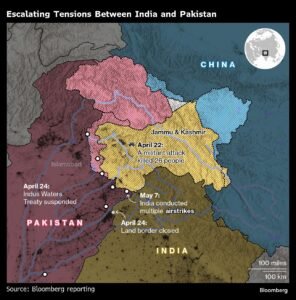
The mutual agreement, reached during a conversation between the Directors General of Military Operations (DGMOs) from both nations, aimed to cease all hostilities starting at 5:00 PM IST. However, as evening approached, accounts of shooting incidents and drone operations surfaced across India’s Jammu and Kashmir, Rajasthan, Punjab, and Gujarat areas, leading to a reaction from Indian armed forces.
The Indian Foreign Secretary Vikram Misri stated during an overnight press conference that the country’s forces were ordered to maintain a state of high alert and respond forcefully to any additional acts of hostility. He characterized the breach as highly serious and affirmed that New Delhi will not accept any challenges.
The incident occurs amidst heightened tensions following four days of strikes and retaliatory attacks between India and Pakistan, which escalated on the morning of May 10.
reached critical levels
As missiles and other precise weaponry showered down on each side’s crucial airbases, the situation grew more complex. Adding to the chaos, discussions about the ceasefire’s beginnings have moved to the forefront of diplomacy.
While India maintains the agreement was strictly bilateral, Pakistan has praised the US for facilitating it. Pakistani Prime Minister Shehbaz Sharif thanked US President Donald Trump and his senior officials, portraying the deal as a product of American mediation. The US State Department also highlighted intense behind-the-scenes efforts by Vice President JD Vance and Secretary of State Marco Rubio.
Even though unsubstantiated reports suggested that Turkey, Saudi Arabia, the UK, and China were involved in some aspects of the mediation, there is no proof indicating that these countries significantly influenced the final accord. In contrast, India minimized the influence of external parties; the nation’s Ministry of External Affairs explicitly stated that broader discussions hadn’t been formalized. This stance contrasts with the U.S. State Department’s claim that both New Delhi and Islamabad concurred to address underlying matters leading up to the conflict through separate “neutral” meetings.
In the midst of escalating tensions, Indian authorities have frequently voiced concerns about the surge of misinformation circulating online—blaming Pakistan as the source. Among these alarming instances of probable fake news are reports suggesting that Pakistan activated its National Command Authority, the body governing their nuclear weaponry, along with unverified tweets claiming that Indian attacks targeted a facility storing nuclear arms. These stories could further heighten the precarious state of affairs.
Although there might still be opportunities for increased interaction between India and Pakistan in the near future, it’s probable that routine minor cross-border conflicts will transform into more regular incidents involving drones and aerial defense activities between these nations.