
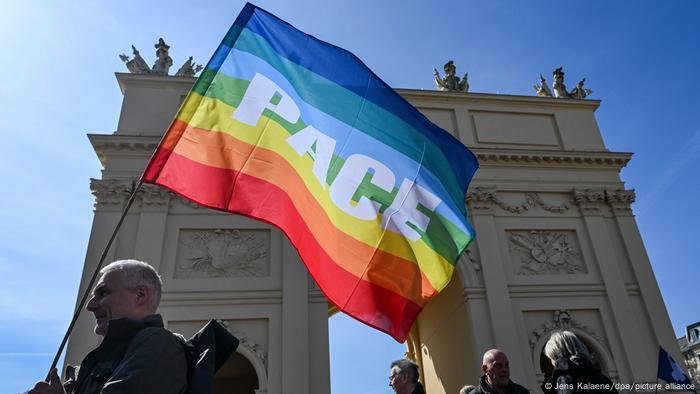
This weekend, thousands in Germany will participate in customary Easter peace demonstrations; however, the peak era of the peace movement appears to be behind us as the government plans to rebuild the nation’s military capacity. Around 120 such events are anticipated nationwide, drawing tens of thousands of participants. Meanwhile, despite preparations underway for these traditional Easter peace marches led by Germany’s ongoing peace initiative, the prospective new administration headed by Chancellor Friedrich Merz intends to invest heavily in national defense—allocating substantial funds towards rearmament efforts—and aims to increase the size of the armed forces from its current level of 83,000 service members up to 203,000 by 2031 through a volunteer enlistment system.
The current sentiment in Germany regarding war and peace is intricate: According to surveys conducted by the Forsa research institute in March and April for media organizations RTL and NTV, although more than half of Germans (54%) express concern about their nation potentially being drawn into the conflict with Ukraine, merely one-sixth of the populace would be willing to take up arms in defense of their country.
The Easter demonstrations are quite varied, as each of the 120 protests publishes distinct manifestos addressing various issues and highlighting differing global conflicts—but according to Kristian Golla, who is assisting in coordinating these events under the umbrella of the Network of the German Peace Movement, several core requests unite them all. These gatherings uniformly condemn “the excessive accumulation of armaments within Germany and Europe,” advocate for increased diplomatic actions aimed at ending wars specifically happening in Ukraine and Gaza, urge for the elimination of all nuclear arsenals, and reject the deployment of intermediate-range ballistic missiles across Europe.
Golla emphasized to DW that it’s crucial to highlight alternative approaches — that focusing solely on increased armaments, armaments, armaments might not be the correct direction,” he stated. “Politicians seem to be proposing a fix that doesn’t actually solve anything. Do we truly believe that after occupying Ukraine, Russia would proceed to take over much of Western Europe? Personally, I have serious doubts about this assertion.
Golla emphasized that the German peace movement isn’t solely made up of pacifists. He stated, “Some members do not inherently object to the use of force.” According to him, the primary aim of this movement is to inquire about ongoing conflicts and explore ways to resolve them. The movement questions whether military action is the sole method for conflict resolution or if alternative approaches could be viable as well.
Difficult times for pacifists
Olaf Müller, pacifist and philosophy professor at Berlin’s Humboldt University, thinks that Germany’s peace movement is at one of its lowest ebbs in decades. “I think the peace movement is demoralized,” he told DW. “And one of the reasons is that if you take to the streets against militarism now you are instantly suspected of playing into Putin’s hands.”
It’s certainly true that despite this week’s protests, the German peace movement has experienced a drastic decline since its heyday in the 1980s, as the Cold War was slowly drawing to a close and freedom movements were spreading across communist Europe.
In 1983, approximately four million West Germans had endorsed what was known as the “Krefeld Appeal.” This appeal urged the West German government to retract its consent for housing medium-range ballistic missiles within the nation—this demand being among the principal objectives of those years’ Easter Marches.
This can be attributed to the fact that Germans are becoming progressively more terrified of war, largely due to recent events at the White House. “Currently, the Germans are afraid since they can no longer rely on the assurance provided by the NATO treaty’s security provisions,” stated Müller.
Müller thinks that there are effective substitutes for military defense. He contends that if Germany reinstates compulsory military service, individuals should also have the option to train in nonviolent civil resistance and civil disobedience instead. (Notably, some communities in Ukraine have employed these strategies against Russian forces.)
Where has the peace movement gone?
Annette Ohme-Reinicke, a sociologist from Stuttgart University and the writer of a book about the history of social movements, believes that Germany’s peace movement has weakened due to various distractions following the conclusion of the Cold War. During this period, society started to “look away” from matters related to warfare and defense.
In the meantime, she argues, Germans have become much more preoccupied with social concerns: The difficulties of inflation, the rise in rents, and simply trying to secure a living have created a sense of anxiety in the population, while a more neoliberal economic system, and the individualism that comes with it, has undermined social movements in general.
“It’s a completely different mood than in the 60s and 70s,” she said. “I think that has made the population more vulnerable to issues that create fear and drives them to feel like they must join one side or another.”
Ohme-Reinicke also argues that there’s a growing disconnect between government concerns about national security and the population’s concerns about their own safety. “I think trying to bridge this discrepancy is currently a huge task for the peace movement.”
Polarization kills peace?
Ohme-Reinicke observes a decline in Germany’s discourse culture alongside heightened polarization, causing individuals to fear condemnation for participating in peace demonstrations.
This issue is compounded by the situation where the Alternative for Germany (AfD), currently backed by one-fourth of all voters based on recent surveys, has taken up a more peaceful position regarding Russia as well. Additionally, members of Germany’s historically leftist peace advocacy groups are reluctant to align themselves with those from the extreme right wing.
For Müller, the crucial point is to exercise caution regarding Germany’s investments—should Germany have to purchase weaponry, these should ideally be of a defensive nature such as air defense systems, surveillance technologies, and logistical capabilities ensuring that German forces can swiftly reach NATO’s eastern frontier for defensive purposes.
Klaus Schlichte and Stephan Hensell, political scientists from the University of Bremen, advocate proactive planning: “Even though this idea might appear extreme right now, those concerned with maintaining Europe’s stability must begin contemplating how to launch a fresh disarmament initiative immediately. The unrestricted permission for arms buildup, which was swiftly approved, ought to serve as motivation for all experts to consider potential resolutions to the security conundrum. This represents the historic duty of conflict studies,” they penned in an article published within the German newspaper Frankfurter Rundschau.
Edited by Rina Goldenberg
As long as you’re here: Each Tuesday, the DW editorial team compiles updates on developments within German politics and society. You have the option to subscribe here for the weekly email newsletter titled Berlin Briefing.
Copyright 2025 DW.com, Deutsche Welle. Distributed by Tribune Content Agency, LLC.